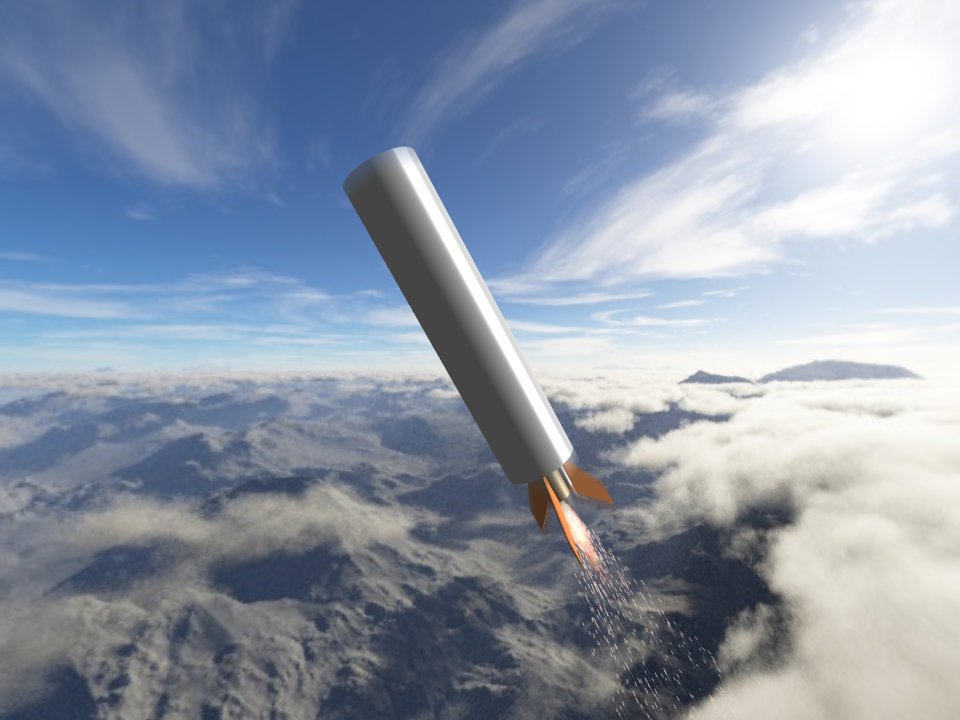
I built this rocket using OpenRocket.
The idea started simple. I had an Estes Alpha III laying around. In December, my MIT acceptance tube arrived. I had a 13-inch-long cardboard tube, about 3 inches in diameter, and I wondered: what if I mounted the Alpha III inside it, perfectly centered, like a rocket inside a sleeve?
That became the MIT Tube Rocket.
Designing It in OpenRocket
Before building anything physically, I modeled the entire design in OpenRocket. That part took some trial and error. The rocket has three main external components:
- A 3-inch diameter outer sleeve (the MIT tube)
- A short transition adapter from 3 inches down to BT-50 size
- The exposed BT-50 tail section with fins and motor mount
Inside the sleeve, I modeled the inner rocket body and adjusted the mass to match the real cardboard tube and internal components.
The key challenge was stability. A large outer tube changes the center of pressure significantly. I had to:
- Adjust fin placement
- Make sure the tail section extended below the sleeve
- Tune the mass distribution inside the sleeve
OpenRocket made it possible to simulate everything before ever launching.
Final Simulation Results
Using an Estes C6-5 motor, the rocket simulates to:
- Apogee: ~80 meters
- Total flight time: ~13 seconds
The flight profile is smooth. It clears the launch rod safely, accelerates steadily, coasts to apogee around 5 seconds after burnout, then deploys recovery on delay.
The open forward tube creates some additional drag, which keeps the altitude moderate. But it has a stable, controlled flight.
Building the Adapter
Physically, the most important part is the adapter between the 3-inch sleeve and the BT-50 tail. That transition must:
- Be centered precisely
- Be rigid
- Not shift under thrust
The tail section extends below the sleeve so the fins are fully exposed to airflow. This was important: if the fins are inside the sleeve, the rocket will not stabilize properly.
What I Learned
This project wasn’t about building the highest rocket. It was about understanding how:
- Drag scales with diameter
- Mass distribution affects stability
- Transitions affect airflow
- Simulation matches real-world performance
Using OpenRocket gave me an idea of how it would launch. I could see the center of gravity, center of pressure, and stability margin before ever putting the rocket on a pad.
It also showed me how dramatically a simple structural change changes the entire flight profile.
Final Thoughts
The MIT Tube Rocket is simple in concept but surprisingly interesting aerodynamically.
It flies to about 80 meters.
It stays in the air for about 13 seconds.
And it proves that even small modifications can completely change a rocket’s behavior.
Most importantly, it started as an idea, became a simulation, and turned into something real.